Humans and Tigers
The relationship with humans and tigers can be complicated. Hunter and author, Peter Hathaway Capstick, mentions in his book, the “Death in the Silent Places”, that he believes that in the past 400 years tigers have killed almost a million people - that’s an average of 2,500 people a year. When resources are low, any predator is driven to find what they need. The most common issue is when tigers prey on farmers' livestock. Usually, when this happens, there is a feeling of strife for the animal. Many tigers have killed domestic cattle and the villagers, in consequence, look for “justice” by hunting the cats. But, nothing is seen as more outrageous, as to when tigers hunt human beings. Scientists theorized this happens when natural food, even livestock, are low, tigers will attack humans if driven enough by hunger.
However, humans are typically not first seen as food. Any predator first has to learn what is prey. There are cases when an epidemic struck colonies in Africa, many people were dying from disease. Their corpses would be left out, and lions would eat the easy meals. However, after this incident, the lions learned humans were also food, and began attacking healthy humans. Another interesting note, there are incidences in Africa when Arab slavers would tie victims to a tree, and later lions, would attack them. This continued to indirectly teach lions that humans were food, and the same can be said for tigers. Now, that generation of tigers teaches the next generation about hunting humans, and this continues so forth.
Additionally, once tigers learn humans are food, they recognize people as an easy target. Usually, if a tiger is aging or injured, hunting the easiest prey is the best solution. There is a report of Tigers of Chowgarth, where there were two Bengal tigers, a mother and a growing cub, around the Kumaon district in India. In 5 years, the two killed 64 people. There are numerous reports mentioning that the earlier attacks were performed by a single tiger, the mother, and the later attacks included both mother and son.
Lastly, within a tigers' natural diet, they eat primates. As humans, head on, we’re vulnerable compared to animals such as Tigers. Because we’ve grown into the technological advanced society, we tend to forget our physical weaknesses.
Traditional Chinese Medicine
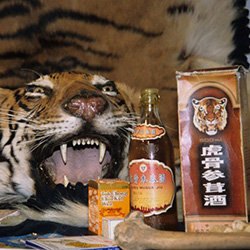
Tigers are a symbol of strength in China. They also symbolize the earth, and are believed to ward off evil spirits. Tigers are part of the Chinese Zodiac, for bravery, and Tigers are also seen as protectors of good people and kill evil men. Because of the mythical power they possess, tigers are believed to have medical healing qualities to their physical attributes. Claws are used to treat insomnia, teeth for fevers, fat for leprosy, nose leather for small wounds or bites, bones used as anti-inflammatory drugs, eyeballs to treat epilepsy, tails for skin diseases, bile to treat children with meningitis, whiskers used for toothaches, brain used to treat laziness and pimples, and dung to treat boils, hemorrhoids, and cure alcoholism. In Hong Kong, China, Taiwan, South Korea, Vietnam and in Chinatowns across Europe and North America, Chinese medicine stores do a steady trade in tiger wines, powder, tiger balms and tiger pills. Many Asian communities believe that tiger bone, in powdered form, or prepared as, “tiger wine,” soothes rheumatic pain and cures ulcers, malaria, and burns.
Below is a video about Traditional Tiger Medicine in China.
Poaching
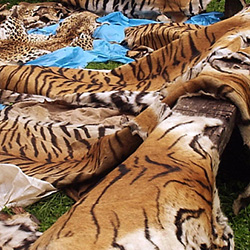
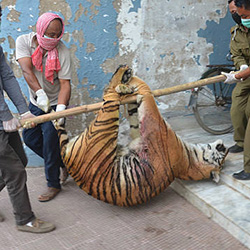
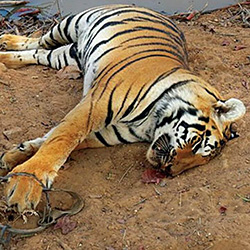
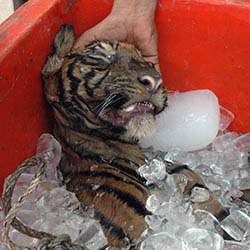
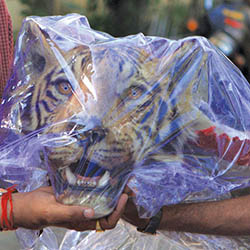
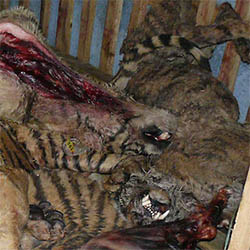
Because of the demand for traditonal medicine, tigers are also prized for their coats. Having their physical skins, and heads is sometimes a smybol of pride and honor. Due to the money earned, tigers are killed for thier skins.
This is a clip from BBC Earth documentary, "Tigers about the House: What Happened Next." Tiger expert, Giles Clark, raises two Sumatran tiger cubs. In this clip you will see Giles, and his wife, Kerri, react to young-tiger skins.
Habitat Loss
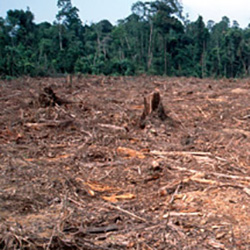
In Asia the population growth demands that more and more land be converted to agriculture. Indonesia, for example, has the same population as the United States, but only ten percent of the land area. Over the past 40 years, China’s population, the largest in the world, has more than doubled; and 99% of China’s original forest habitat has been destroyed. In regions of Sundarbans, India, rising sea levels, causes tigers to move inland, causing confrontation with villagers. Since more and more of their habitat is lost, they are forced to live in areas that they never inhabited before, finding a way to survive. Many zones are destroyed to build homes, and keep livestock. Tigers often come into these areas and feed on the domestic animals as a food source. Forests have been deforested, using the trees for paper products, most commonely tissues and paper towels.
The video below was produced by the World Wildlife Fund, bringing awareness to Sumatra, Indonesia, the home of the Sumatran Tiger. It calls out the company, PASEO, using fiber from the Asia Pulp and Paper (APP). APP has destroyed 5 million acres of the Sumatran rainforest.